There is no funeral home in Haymarket. The town is three or four blocks of Washington Street against the Bull Run Mountains, with St. Paul's Episcopal Church — one of the handful of buildings that survived the burning of the town in 1862 — still standing in the old core, and a service held in Haymarket is held in a church, not a chapel. The arrangements are made somewhere else. For most families in 20169 that means Manassas, twelve miles out: Pierce Funeral Home on Center Street in Old Town, and Baker-Post Funeral Home on Nokesville Road. Southwest, out Route 15 to Route 29, it means Moser Funeral Home in Warrenton. Southeast it means Mountcastle Turch Funeral Home in Dale City. Interment lands at Stonewall Memory Gardens on Lee Highway in Manassas, at a church burying ground, or — often, in this county — at a national cemetery. So the first thing a sympathy order needs is not a flower choice. It is the name of the funeral home, the date, and the hour of the service, because everything else follows from those three.
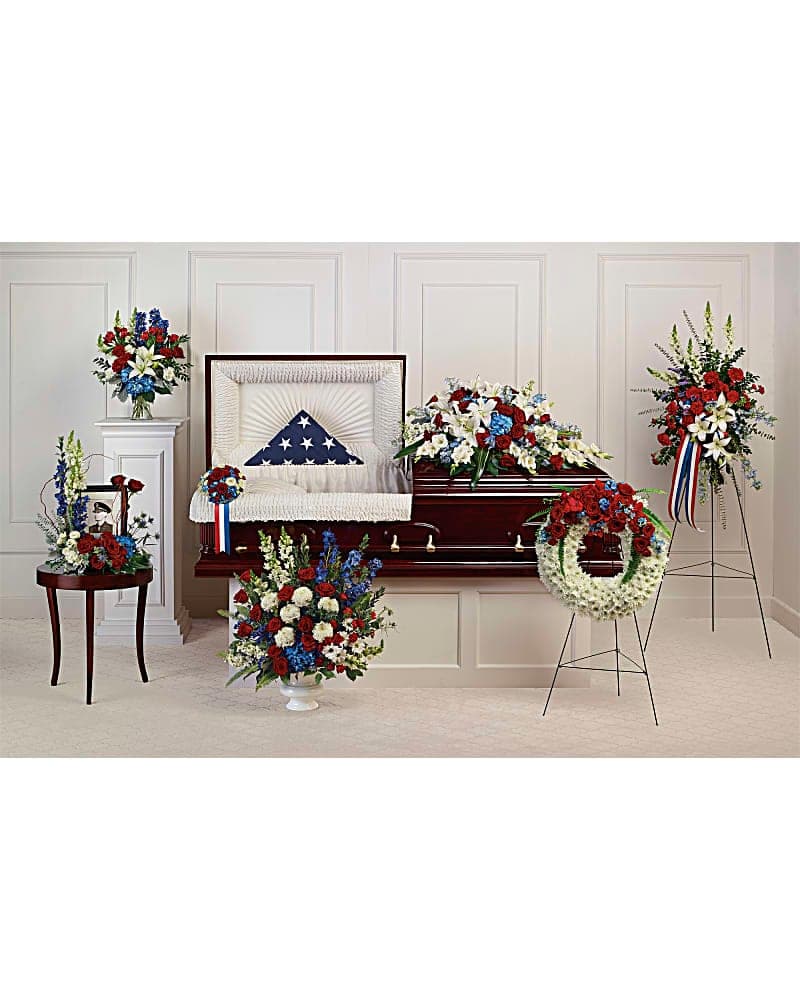
A national cemetery is a different kind of delivery, and a great many Haymarket families end up at one. Quantico National Cemetery in Triangle, on Joplin Road, is roughly twenty-eight miles south of the town, and Arlington National Cemetery is a little under forty miles east — both are entirely ordinary destinations for a Prince William County family, given how much of this county's population has served or works for the government, and with Marine Corps Base Quantico sitting immediately alongside the first of them. What is different is the mechanics. Committal services at a national cemetery run to a schedule, in sequence, at a covered shelter rather than at the grave itself, and families are staged and moved through. That means flowers do not get sent to a grave site and do not get sent to the cemetery as a street address with a name on it. They are coordinated through the funeral home handling the arrangements, which is the party that knows the shelter, the hour and where the family will be standing. Give us the funeral home and the service time and the shop works backwards from there. If you have only a section number, that is the moment to telephone.
Two things decide more than the flowers do: the notice, and the card. Funeral notices carry the service details, and they frequently carry a line about what the family has asked for — often that donations go to a named charity in lieu of flowers. Read it before you order. That line is not a bar on the gesture; it is guidance about where the gesture belongs, and the usual reading is that the chapel gets nothing and the house gets something. Then the card, which people rush and should not. Address it to the person you actually know rather than to the family as a body, and sign it the way that person would recognise you — a surname on its own, in a room holding forty arrangements, identifies nobody. If you are writing on behalf of a workplace, name the workplace; if you are writing as a neighbour, say which street. And keep it short. Two sentences that use the name of the person who died will be read twice and kept in a drawer. A paragraph will be skimmed at an hour when nobody can hold a paragraph, which is a waste of something you meant.