Birmingham is where Alabama goes when it is seriously ill, and that concentrates get-well flowers into a few Southside blocks more tightly than in almost any comparable city. UAB Hospital sits at 1802 6th Avenue South, the largest hospital in the state and the hub of a campus that runs for blocks: the Kirklin Clinic at 2000 6th Avenue South handles the outpatient load from an I.M. Pei building, the O'Neal Comprehensive Cancer Center is the state's National Cancer Institute-designated center, UAB Highlands is up at 1201 11th Avenue South, the Women & Infants Center is on the same avenue grid, Callahan Eye is at 1720 University Boulevard, and Spain Rehabilitation sits inside the same complex. Children's of Alabama, at 1600 7th Avenue South, is the pediatric referral hospital for the entire state, and the Birmingham VA Medical Center is a block over at 700 19th Street South. St. Vincent's Birmingham is on St. Vincent's Drive just west of the campus. That means a delivery driver on the Southside is often doing two or three hospitals on one run.
Before you choose an arrangement, settle the rule, because on this occasion the recipient's unit decides what you are allowed to send. One call to the nurses' station answers it in a sentence. Intensive care units, transplant floors and bone marrow or stem cell units commonly allow no flowers and no plants at all — soil and standing water are an infection-control problem for a patient with no immune defense to spare — and UAB runs one of the country's large transplant programs, so this comes up here far more often than the size of the city would suggest. Oncology floors at O'Neal typically mean no lilies and nothing perfumed: oriental lily, stock, freesia, hyacinth and paperwhite narcissus are the usual offenders, and nothing planted in soil. Children's of Alabama layers on its own conditions: latex balloons are refused outright, a policy pediatric hospitals hold because of latex allergy, and staff will be grateful for something compact, because a child's room is already carrying monitors, a parent's recliner and a fold-out cot. Behavioral health units generally will not take glass.
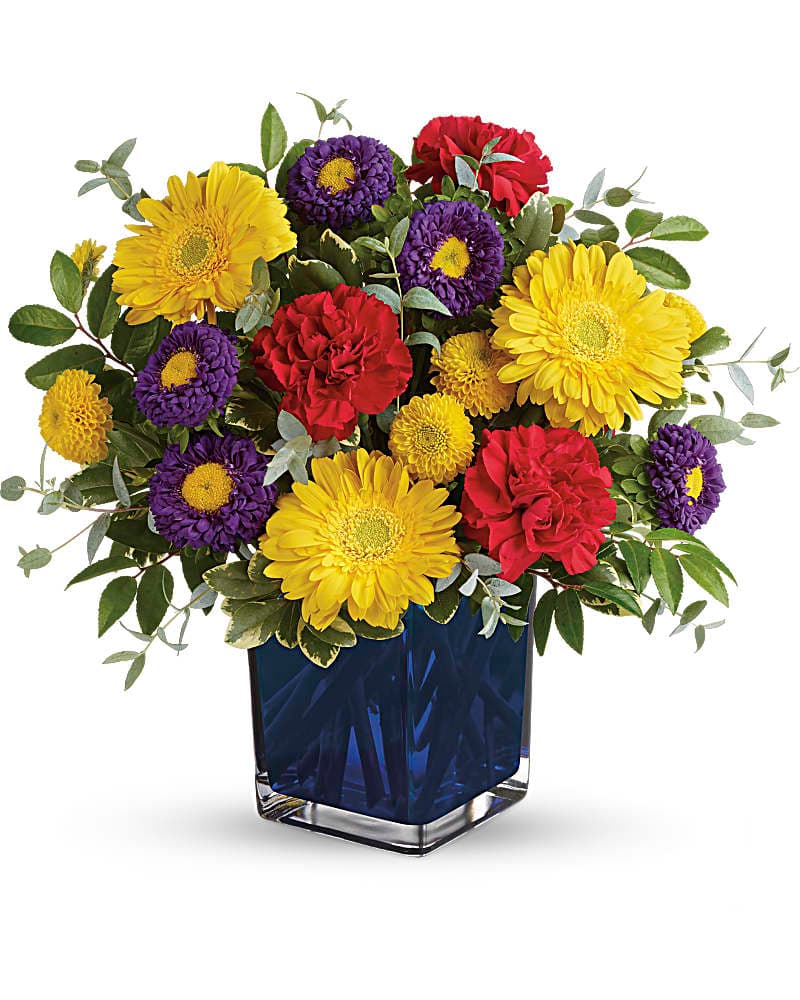
The trap specific to this catalog is worth naming. The Simply Elegant Spathiphyllum — the large peace lily — is the traditional Southern hospital and sympathy plant, and it is genuinely lovely, but botanically it is not a lily at all and that is not why floors refuse it: it is a potted plant in soil, which is exactly what oncology, transplant and intensive care wards will not accept. Same with Teleflora's Lush Leaves Pothos Plant. Both are excellent gifts sent to the patient's home for the recovery weeks after discharge, and a poor choice for a room on 6th Avenue South. What works on a floor is a compact cut arrangement in a sturdy vessel a nurse can move one-handed: carnation, chrysanthemum, gerbera, spray rose, alstroemeria, snapdragon, lisianthus and solidago, every one of them near-odorless and stubborn about staying fresh in a warm room. Teleflora's Mid Mod Brights Bouquet is the most floor-friendly thing on this rail; better still, name your price, ask for designer's choice, and let the shop build from whatever came in scentless and hardy that week.
The last thing is the one senders get wrong most often: the patient may not be there. Most stays in this metro are short, and an arrangement that arrives the afternoon after a discharge sits at a desk until somebody throws it out. If you are ordering on day two of a three-day admission, send it to the house. The same logic applies to the enormous outpatient side of this district — infusion chairs at O'Neal, dialysis, day surgery, physical therapy, and the clinic network running through the Kirklin Clinic and out along the 280 and Riverchase corridors. An appointment measured in hours leaves nobody a place to park a vase, and most of those rooms ask for no flowers and no fragrance at all, because the person in the next chair may be one day out from chemotherapy. The house is the right address, and the best hour is the evening of a treatment day or the morning after it. The 60-mile radius also puts the regional hospitals in reach: Shelby Baptist in Alabaster, Medical West on the Bessemer side, St. Clair in Pell City, Walker Baptist in Jasper, Cullman Regional, Coosa Valley in Sylacauga and the Anniston, Gadsden and Tuscaloosa hospitals at the edge of the circle.