Each of those buildings holds a different kind of patient, and that shapes the gift more than the mileage does. USA Health University Hospital, on University Hospital Drive, is the trauma service and the burn center for this stretch of the coast, which means its beds fill from the highways and the working waterfront rather than from the surrounding streets — wrecks on I-10 and I-65, injuries out of the shipyards and off the docks and from the plants down at Theodore, patients brought in from Washington and Clarke counties, from across the Mississippi line, from the western end of the Florida panhandle. Two things follow. A burn unit is the one place in a hospital where flowers are a clinical problem rather than a tidiness problem: damp foam, standing water and potting soil all carry organisms, and somebody without an intact skin barrier cannot be in a room with them, so nothing of that sort is admitted. And the person your money is really for may have driven two hours to be here. Ask where the family is sleeping — often a motel off Airport Boulevard or out by the interstate — and send it there instead, where somebody will actually sit down in front of it.
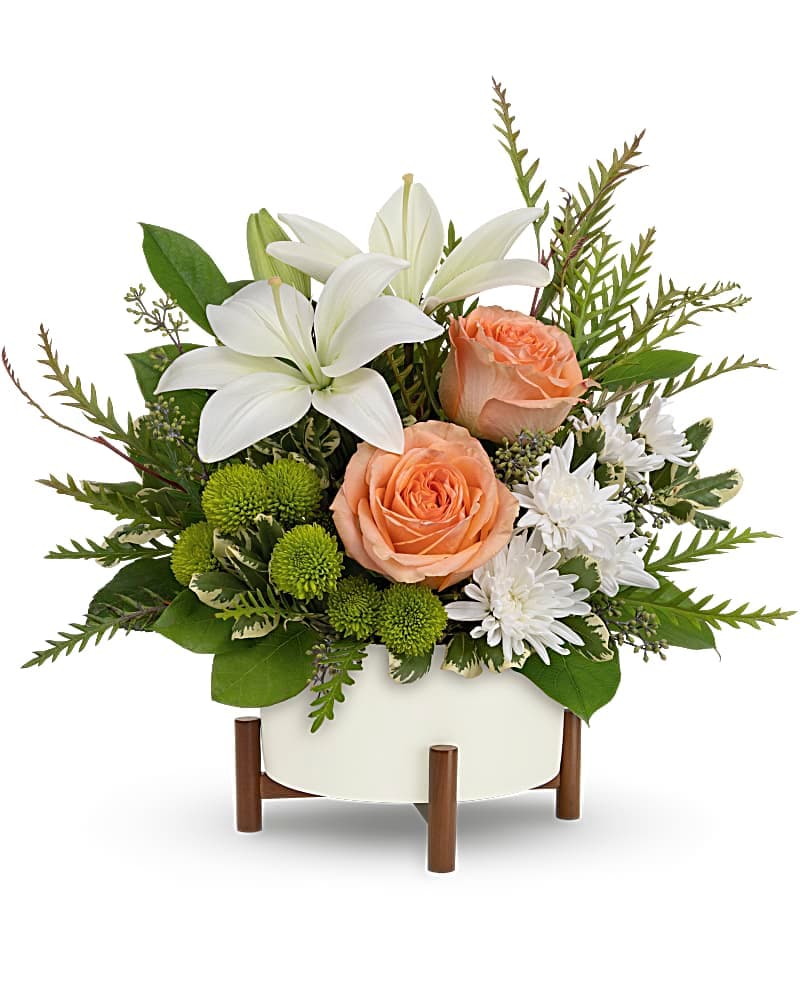
Now picture the room rather than the bouquet. Space beside a hospital bed is contested: the cabinet is narrow, the tray that swings across the mattress belongs to meals and medication, and the only surface nobody is fighting over is the sill — which is on the far side of whoever has come to visit. So a design that is short and weighted low can hold its place on the cabinet, while a tall glass cylinder gets lifted to the window the first time anyone needs the room back, and the window is the wrong side of the bed. Staff move these things with one hand while carrying something else, which argues for a wide foot and a vessel that can be gripped. Lilies come out for a physical reason: the anthers on an open lily shed a rust-coloured dust that marks a gown and a pillowcase for good, and behind a closed door the perfume has nowhere to disperse to. Mobile supplies a second argument on pollen that most cities cannot. For several weeks each spring this whole city goes yellow under oak and pine, thick enough to write in on a car bonnet, and anyone admitted with a chest complaint in that season has already spent a month at the far edge of their tolerance. Scent deserves the same restraint, since shared rooms remain ordinary here and the man in the second bed was never consulted about what the room would smell like.
Four Mobile addresses change the answer entirely. At USA Health Children's and Women's Hospital on Center Street, the region's newborn intensive care accepts neither cut flowers nor plants, and rightly so — the gift there is for the parents, and if they are staying at the Ronald McDonald House near the hospital, that is the door where a delivery will actually find them. Psychiatric admissions in this city run through AltaPointe Health, and those units take out anything that can be broken, sharpened or knotted, which rules out glass, florist wire and long ribbon; what a bench can build instead is a short, soft, unbreakable arrangement with no armature running through it, and saying so on the order is what gets it made that way the first time. At the Mitchell Cancer Institute an infusion appointment is most of a day in a recliner and ends with the patient driving themselves out of the car park, so flowers left at that building greet an empty seat — aim at their kitchen table the following morning, which is when the tiredness actually lands. And the VA clinic on Springhill Avenue treats veterans as outpatients rather than admitting them, so a get-well gift for somebody being seen there belongs at his own house.