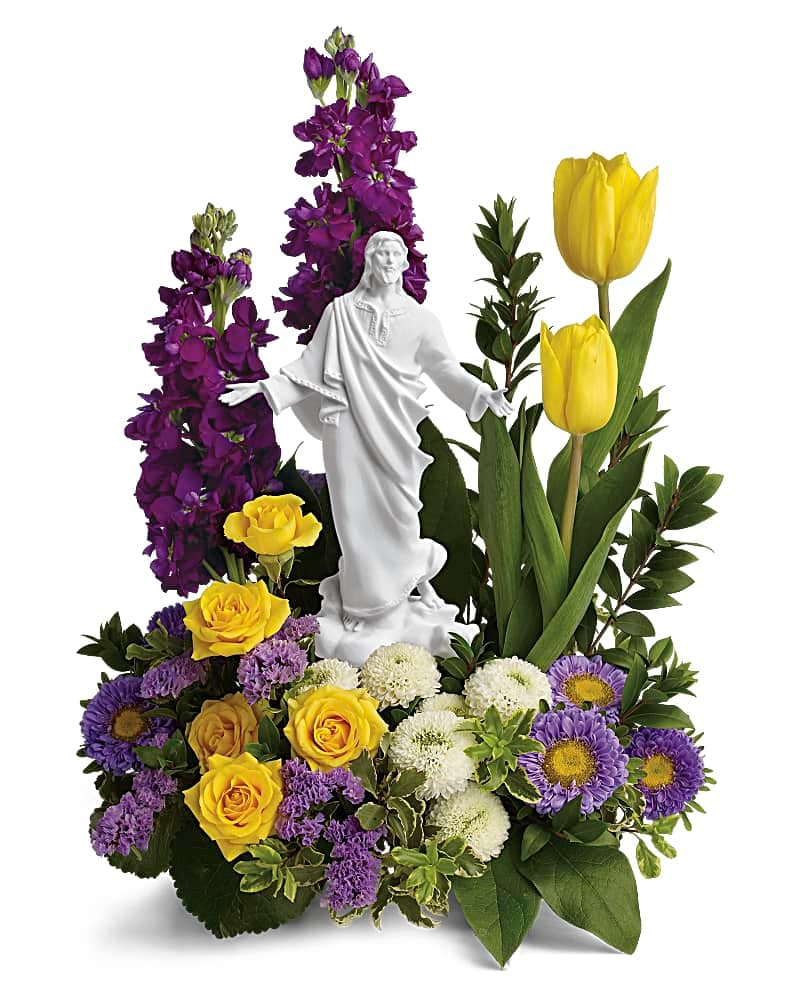
Sympathy work in Marietta runs along one street more than any other. Church Street NE carries Wellstar Kennestone Hospital at 677, the region's Level II trauma center where a great many Cobb County deaths are pronounced; a few blocks south it passes the historic Marietta chapel of Mayes Ward-Dobbins Funeral Home and Crematory, the oldest-established funeral name in town, which also keeps a chapel out on Macland Road for west Cobb families; it passes First Baptist Church of Marietta, where a large share of the city's funerals are actually held; and at 156 it passes Kmikewhittle Designs, the closest studio on this grid at 1.1 miles from the centroid. That compression is useful when you are making calls from another state at nine at night. It also explains why the single most helpful question you can ask the family is not what flowers they like but which building the service is in — in Marietta the visitation and the funeral and the burial are frequently three different addresses, and a piece sent to the wrong one of the three is a piece nobody sees.
The chapels and congregations that carry Marietta funerals are specific places with specific rhythms, not a category. Mayes Ward-Dobbins handles visitation in its own rooms and then follows the family to a church for the service more often than not. First Baptist Marietta on Church Street and St. Joseph Catholic Church on Lacy Street anchor the downtown side; the Catholic Church of St. Ann on Roswell Road, Johnson Ferry Baptist Church on Johnson Ferry Road and Mount Bethel United Methodist on Lower Roswell Road carry the East Cobb side, and all three are large enough buildings that a delivery needs a door named in the notes rather than a street address alone. Turner Chapel AME on North Marietta Parkway and Zion Baptist Church on Lemon Street are the historic anchors of Black Marietta, the Lemon Street corridor that held the city's Black school before integration; homegoing services there often run long and draw a crowd that fills the lot, so a delivery wants to be in the building well before the first car arrives. In East Cobb, Temple Kol Emeth and Congregation Etz Chaim serve the Jewish community, where the family will usually tell you directly whether flowers are welcome and where food sent to the house during the week of mourning is the more common gesture. Ask. Nobody has ever been offended by the question.
Burial in Marietta has a geography of its own, and one of the three main grounds changes the rules. Marietta National Cemetery on Washington Avenue, laid out after the Civil War for Union dead from the Atlanta Campaign, is federal ground, and if the family tells you the interment is there, plan differently: committal services at national cemeteries are held at a shelter rather than at the grave itself, the service is short, the cemetery sets its own limits on what may be left on a grave, and arrangements are cleared when they wilt or when the mowing schedule requires it. The workable move is to send the piece to the funeral home for the visitation and service, and send something to the family's house for the week after. A short walk away, the Marietta Confederate Cemetery and the adjoining Marietta City Cemetery off Powder Springs Street hold the nineteenth-century town; they are historic ground with long-standing family plots, and a graveside service there is genuinely outdoors with no shelter, which matters in August. Kennesaw Mountain rises just northwest of all of it — the battlefield park that made these burial grounds necessary in the first place, and still the horizon line from half the cemeteries in town.