About St. Petersburg sympathy
Sympathy work in Pinellas County is shaped by one demographic fact and it changes almost every practical decision. This is one of Florida's oldest-skewing and most densely settled counties, and a very large share of the people mourned in St. Petersburg moved here in retirement, which means the adult children are frequently in Columbus, Grand Rapids, Buffalo or Long Island rather than in 33704. The consequence is that the funeral is often not here. A body is cremated locally — Florida's cremation rate is among the highest in the country and direct cremation is the default in this county, not the exception — the ashes travel north, the service happens in the parish the family grew up in, and what is needed in St. Petersburg is something else entirely: flowers to the surviving spouse's condo on the day the house goes quiet, or to a memorial gathering held here three weeks later in a clubhouse, a church hall, a restaurant's back room, or on a boat going out past Pass-a-Grille to scatter ashes in the Gulf. If you are ordering from out of state, the single most useful question is not which chapel but which room will have people in it, and when.
Where a chapel or church is involved, these are the St. Petersburg names that recur. Anderson McQueen, the city's largest and longest-established funeral firm, runs the chapel on Dr. Martin Luther King Jr. Street North and handles a large share of the metro's arrangements. The Cathedral of St. Jude the Apostle on 5th Avenue North is the seat of the Diocese of St. Petersburg and therefore the city's principal Catholic funeral church, and burials from it often go up to Calvary Catholic Cemetery in Clearwater, at the far northern edge of this 18-mile radius — a detail worth knowing, because the Mass and the interment can be twenty miles and a full hour apart. St. Peter's Episcopal Cathedral on 4th Street North downtown is the church the city took its patron name from. In Midtown and along the historic 22nd Street South corridor known as the Deuces, Mt. Zion Progressive Missionary Baptist Church on 20th Street South anchors a homegoing tradition where the service is a larger, longer, more musical event than the county average and where the flower order is usually placed by a church committee rather than one family. Memorial Park Cemetery on 49th Street North is the in-city burial ground most of our benches reach fastest, and hospice work across the county runs through Empath Health's Suncoast Hospice, long the dominant provider in Pinellas.
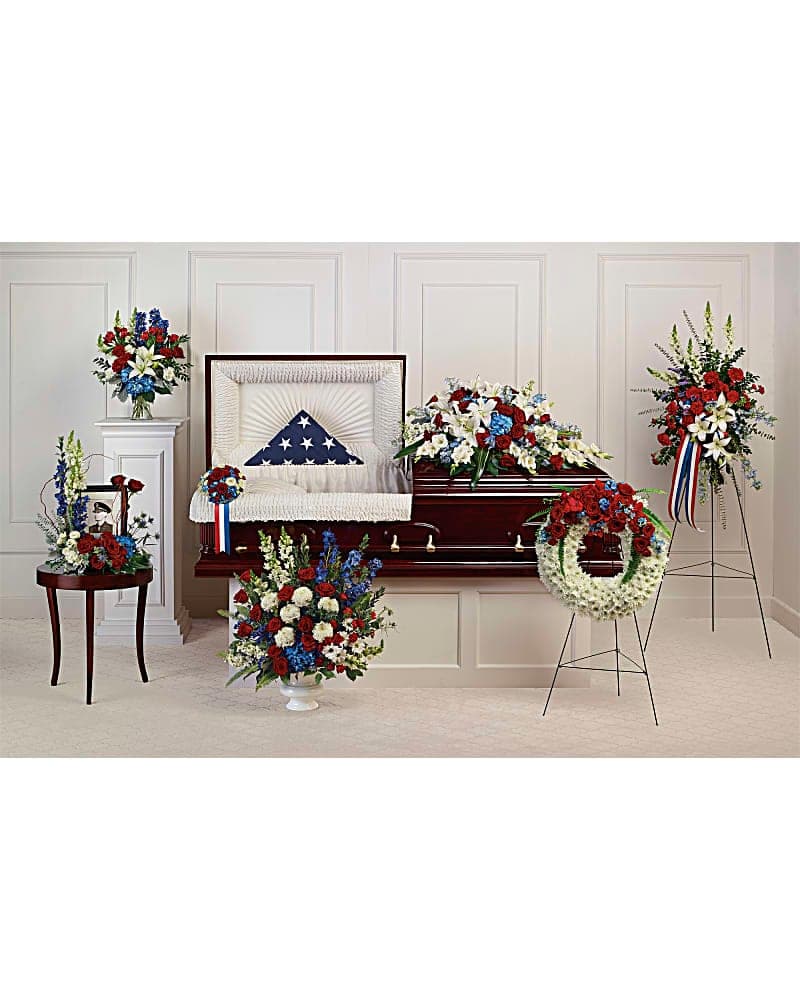
Bay Pines deserves its own paragraph, because a national cemetery does not work like a private one. Bay Pines National Cemetery sits on the grounds of the C.W. Bill Young VA Medical Center at 10000 Bay Pines Boulevard, in the corner of the county where Seminole, Bay Pines and the beaches meet — which happens to make it closer to Seminole Garden Florist and Haye's Florist out on Park Boulevard than to anything downtown. At a national cemetery the committal is held in a shelter on a timed schedule rather than at the open grave, and family cars queue for a slot; flowers travel with the funeral director to that shelter and are placed on the grave afterward, glass containers are not permitted, and arrangements are cleared by cemetery staff once they fade. That means a delivery addressed to a section and grave number on the morning of a committal is usually the wrong instruction — send it to the funeral home, or to the family's house for after. Capacity at Bay Pines is limited and a great many Pinellas veteran families are interred instead at Florida National Cemetery in Bushnell, an hour and a half up the interstate and far outside our radius, so graveside flowers for a Bushnell service should be arranged near Bushnell, not here. What we can reliably do for a veteran's family in this city is the home delivery, the reception piece, and the arrangement that arrives on the anniversary nobody else remembers.