Someone from Capitol Hill has been admitted — which hospital is it likely to be?
+
Almost certainly not the one on the Hill. Kaiser's campus at 201 16th Avenue East is outpatient, so ask the family for a building name first. Scheduled surgery and most medical admissions from these blocks land downhill on First Hill: Swedish at 747 Broadway, Virginia Mason at 1100 Ninth Avenue. Anything sudden is usually Harborview at 325 Ninth Avenue. Neurosurgery and much of the cardiac work go a mile east to Swedish Cherry Hill. Cancer care runs north to UW Medical Center Montlake, and a Kaiser member may be across the lake at Overlake.
How does delivery to Swedish First Hill on Broadway work?
+
It is the shortest hospital drive on this page — straight down Broadway, under two miles, no bridge and no freeway, and the campus that takes the largest share of these orders. Send the full name as admitting recorded it and the unit, because First Hill is several connected buildings rather than one tower and a lobby drop with only a first name goes nowhere. If the patient is on the Swedish Cancer Institute's inpatient side, say so in the notes: that floor turns on the day's blood counts, so the shop telephones the unit before it builds rather than after.
Can you send flowers to Harborview?
+
To most of it, yes. Harborview is the Level I trauma center for four states, so a good share of its patients arrive with no Seattle address and no local family to ask, and the ward is often the only detail anybody has. Two services decline flowers as standing policy: the burn center, where infection control governs everything entering, and the inpatient psychiatric floors, where glass, wire and ribbon are the issue. Everywhere else the building's scale is the real obstacle. Seattle Flowers at 600 Second Avenue and Tiffany's Blooms Seattle on South Jackson Street both sit inside Harborview's own 98104.
My friend is on the transplant floor at UW Medical Center. Will flowers be allowed?
+
No — and far better to learn that here than at the ward door. The inpatient transplant and cellular-immunotherapy service that Fred Hutchinson Cancer Center runs on the Montlake campus takes nothing living at all — no cut stems, no plants, no soil, not even dried. Seattle is where marrow transplantation was first performed, and those floors have held the strictest rules in the region ever since. The objection is less the pollen than the warm standing water in the vessel, plus the spores in potting soil. Send something for the family lounge now, and flowers to the house on discharge day.
Why are the hospital builds unscented and lily-free by default?
+
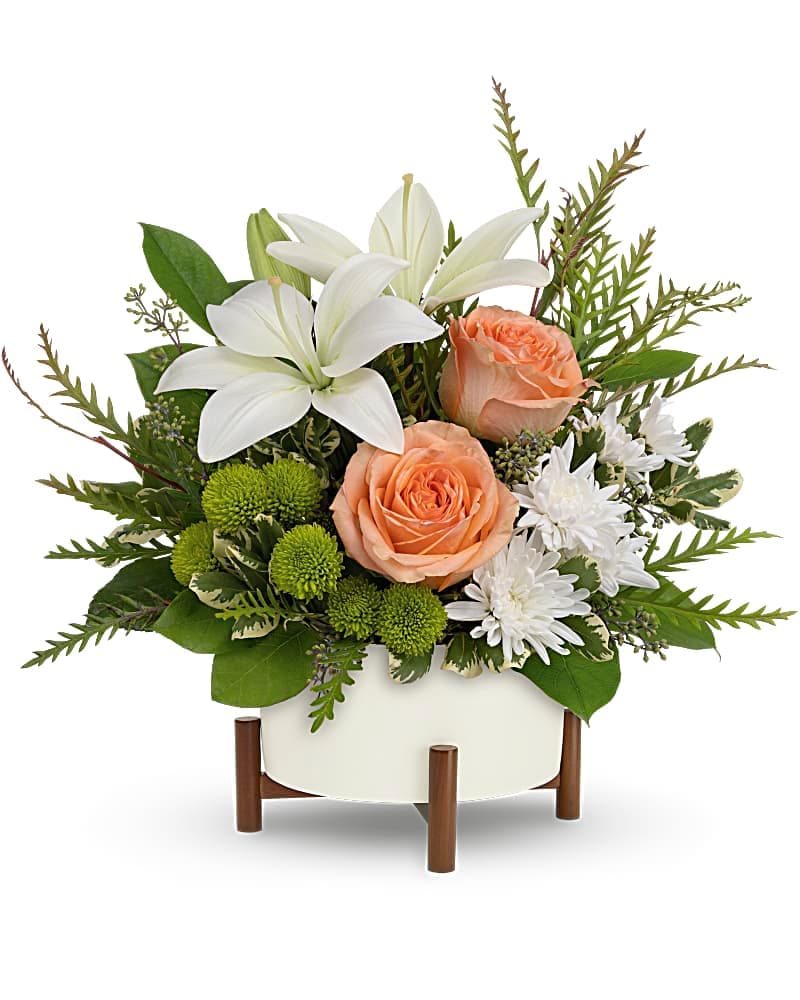
Two practical reasons. Heavy scent works against nausea being managed after anesthesia or a treatment cycle, and in a double room your choice of perfume is imposed on a stranger who never got a vote — so stargazers, freesia, hyacinth, paperwhites and dense stock come out. Lilies lose their place for a second reason: the anthers shed a rust-colored dust over bedding and hands, and somebody on shift has to clean it up. What is left still looks generous — garden roses, ranunculus, lisianthus, snapdragon, hellebore, built low and dense. If lilies are their favorite, we make that one for the house instead.
A neighbor is at Bailey-Boushay House on East Madison. Is that different?
+
Very. Bailey-Boushay House at 2720 East Madison Street, a mile east of Broadway on the Madison Valley edge of the Hill, is a skilled-nursing residence rather than an acute ward — it opened in 1992 as the first facility in the country built specifically for people living with AIDS, and has been part of this neighborhood's history since. Stays are counted in weeks and months, the room becomes somebody's home, and flowers are welcome in a way they are not on a transplant floor. That argues for a living plant: it is still alive when a third bouquet would already have been thrown out.
They are recovering at home on Capitol Hill. What changes?
+
Every clinical rule disappears and a delivery problem takes its place. Send the scented, lily-heavy, generous thing they actually want. The catch is the door. These blocks are dense pre-war brick walk-ups with a locked lobby and a buzzer nobody answers midweek, plus a decade of new mid-rise where the driver is routed to a parcel room and the flowers sit in the dark until evening. Give the unit number, a cell number and permission to text on arrival. Parking is restricted the length of Broadway, 15th and 19th, so the driver has minutes rather than a quarter of an hour.