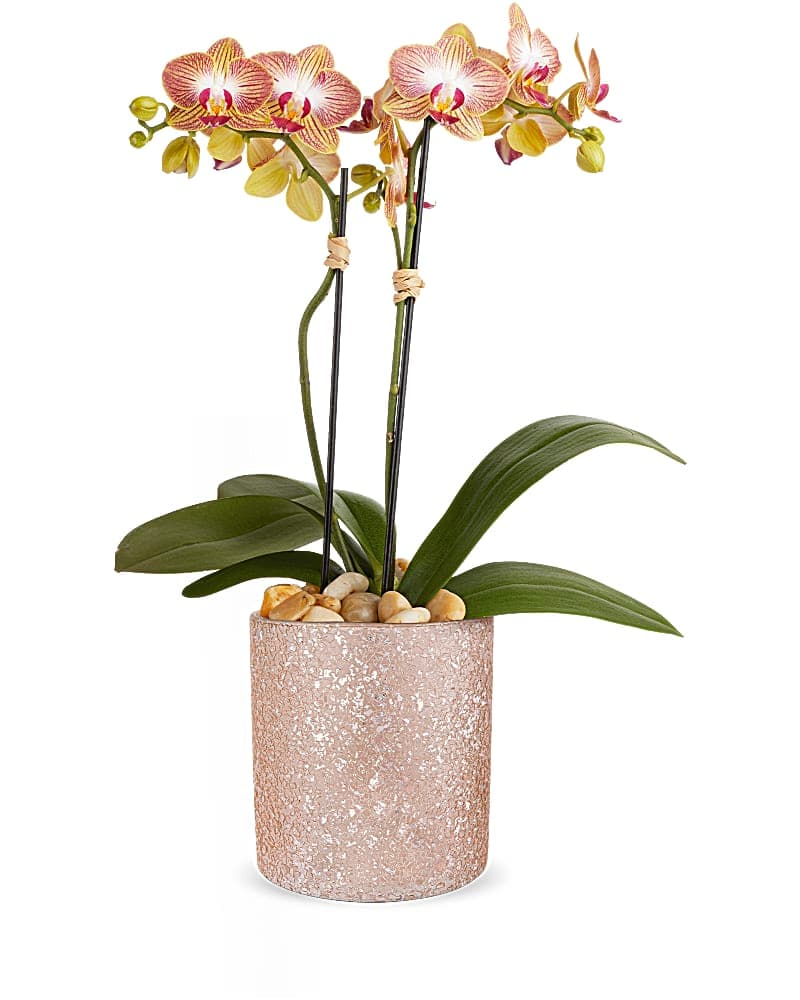
What a floor will accept is a question about that floor, and it takes one phone call to answer. Ask the unit desk — not the main switchboard — two things: whether anything can come to the room at all, and whether they want the container swapped. On the Dwight Way behavioral-health campus the flowers are rarely the issue; the vessel is, so expect glass, wire and long ribbon to stay at the desk, and ask us for a light basket or a plastic-lined vessel that a staff member can hand over intact. On the cancer and intensive-care halls at the Ashby campus and on Pill Hill, the question to put to the nurse is about pollen-shedding stems and about scent in a shared room, and the answer sometimes is simply *not this week* — which is worth knowing before a driver makes the trip rather than after. At the children's hospital on 52nd Street, if a balloon is going with the flowers, ask for mylar rather than latex. And when the patient is a newborn on the Ashby campus, where a large share of the East Bay's babies are delivered, the flowers belong in the mother's room rather than anywhere near an intensive-care nursery. Write whatever you learn into the order notes. A bench will build to a restriction if it knows about it; it cannot guess.
Then the question that decides more Berkeley get-well orders than any other: room or house. Do the discharge arithmetic first. A gallbladder, a knee, a bad pneumonia — most of these are two or three nights, and an arrangement sent on the third morning arrives to a made bed. Worse, a hospital piece that lands on the day someone goes home becomes luggage: it rides out on a lap in a wheelchair, gets wedged into a footwell on Ashby Avenue, and arrives at the house with half its water on the seat. If the stay is longer than overnight and you are not certain of the day, send to the house instead. Nothing is lost — the flowers are there when the person walks in, which is the moment they are least able to do anything for themselves and most likely to notice that someone thought about them. If you do send to a room, keep it small on purpose. A hospital surface is about eighteen inches of shared laminate holding a water jug, a phone charger, a spectacle case and a plastic cup of pills, and a tall arrangement gets moved to a windowsill behind the blinds inside an hour.
Home recovery in Berkeley has a specific physical problem, and it is the staircase. The 1920s apartment buildings on the Southside blocks — Durant, Channing, Dwight, Haste — are three and four storeys with no lift, and the flat you want is usually the top one. Up above Euclid Avenue, along Cragmont and Grizzly Peak and on the lanes that climb off Marin Avenue, the house frequently sits below the roadway, with the address stencilled at road level on a garage or a gatepost and the front door two flights down. Somebody six days out of surgery cannot carry a ten-pound glass cylinder up or down any of that, and a well-meaning heavy arrangement turns into a chore for whoever is helping. So: pick the low, light, ready-made option, ask the driver to set it inside the door or the porch rather than on an open step, and put a mobile number on the order with a line like *knock, do not ring — she is sleeping*. Recovering people sleep through doorbells, and Berkeley's deep shaded porches are forgiving enough that a bouquet left in one for an hour comes to no harm. The neighbours in this city will already have brought soup from the Berkeley Bowl on Oregon Street or a bag from Monterey Market on Hopkins Street; flowers are the thing nobody thinks to bring and the thing that is still there on day five.